Fabric is the single decision that shapes how a napkin feels in a guest’s hand, how it launders over a year of service, and what it costs to keep a full par stock on the shelf. Size and hemming matter, but they are refinements on top of the material choice. This guide walks through the fabrics used for custom napkins, what each one actually does at the table and in the wash, and how weight and price track with service level so you can specify with confidence.
What the fabric actually changes
Three properties separate one napkin fabric from another: absorbency, wrinkle behavior, and how the material ages through repeated laundering. Absorbency governs whether the napkin does its job during a meal. Wrinkle behavior decides how much pressing labor a linen program adds. And aging determines your real cost of ownership, because a napkin that thins or greys after a hundred washes is more expensive at $1.50 than a napkin that survives several hundred washes at $3. A common industry durability claim is around 500 wash cycles, but in practice many mid-weight cottons show visible wear closer to 100 washes, while genuine flax linen tends to soften and improve rather than degrade. Keep that gap in mind whenever a spec sheet quotes a single headline number.
Genuine flax linen, the premium performer
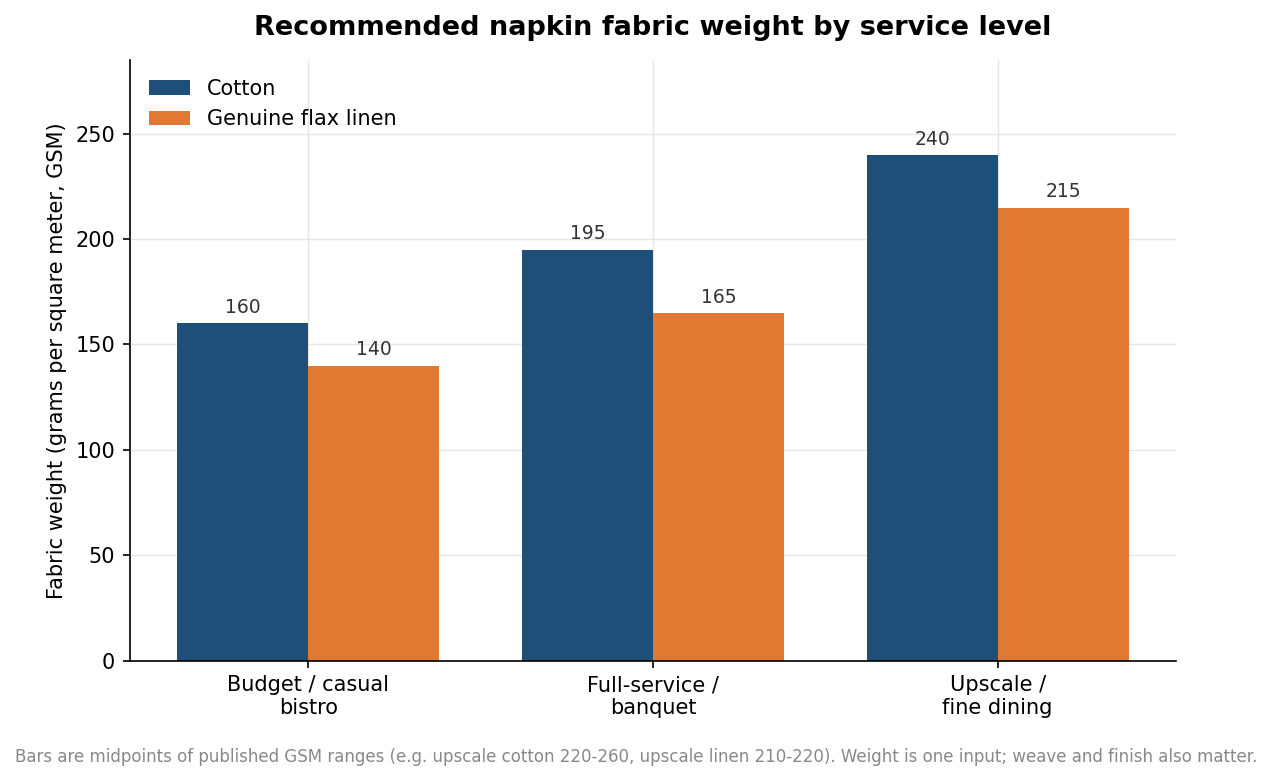
Real flax linen has a natural slub texture and a hand that reads as upscale the moment a guest picks it up. It is highly absorbent, it becomes softer with each wash because of the natural pectin in the fiber, and it carries the strongest sustainability story of the common options. The trade-offs are wrinkle and price. Linen creases readily, so a linen program needs pressing or a deliberately relaxed, folded presentation. On weight, linen runs a little lighter than cotton for the same service level: roughly 130-150 GSM for casual use, 160-170 GSM for full service, and 210-220 GSM for fine dining. Genuine flax also sits at the top of the price band, which is why it is usually reserved for the tables where the tactile impression justifies the cost.
Cotton and poly-cotton, the workhorses
Cotton is the most common napkin fiber in North American hospitality for good reason: it is soft, genuinely absorbent, takes a press well, and spans an enormous quality range. Entry-weight cotton around 150-170 GSM suits bistros, while steakhouse and banquet cotton climbs to 220-260 GSM for a substantial drape. The catch is upkeep. Cotton wrinkles, needs ironing to look crisp, and the cheaper grades are the ones most likely to thin early. Poly-cotton blends, typically 65/35 or 50/50, trade some absorbency for wrinkle resistance and a lower laundering burden. They are the pragmatic middle: more forgiving than pure cotton in a busy laundry cycle, more breathable and natural-feeling than pure polyester. If your staff presses napkins by hand, a blend can pay for itself in labor even though the fabric costs a little more per piece.
Polyester and spun polyester, durability and cost
Polyester is built for volume. It is wrinkle-resistant, holds its shape through aggressive commercial laundering, and resists staining better than natural fibers, which is why high-turnover venues and event rental inventories lean on it. Standard woven polyester feels the least natural of the group, but spun polyester (often sold as momie or visa) is spun rather than filament, which gives it a softer, more cotton-like hand while keeping polyester’s toughness. On cost it is the value leader, frequently the cheapest durable option per napkin. The honest downside is absorbency: polyester moves moisture around more than it soaks it up, so it is a weaker choice where the napkin needs to handle a genuinely wet, sauce-heavy meal.
Weave and finish, the detail beyond fiber
Fiber sets the character, but weave decides the surface. A plain weave is the everyday construction: even, durable, and easy to launder. Twill adds a subtle diagonal rib that hides light soiling and drapes with a bit more body, which is part of why it shows up in heavier service napkins. Damask is the dressiest of the common weaves, using the contrast between satin-faced and matte areas to work a pattern directly into the cloth rather than printing it on, and it reads as formal without any added color. A satin band or a woven border, meanwhile, is a finish rather than a weave: it frames the napkin and signals care without changing the base fabric. These choices interact with hemming, too. A tightly woven, heavier cloth resists the corner fraying that thinner napkins show first, so specifying a slightly heavier weight or a denser weave often does more for longevity than any single laundering rule. When you compare quotes, make sure you are comparing the same fiber, the same weight, and the same weave, because any one of the three can swing both feel and price.
Matching weight and budget to the room
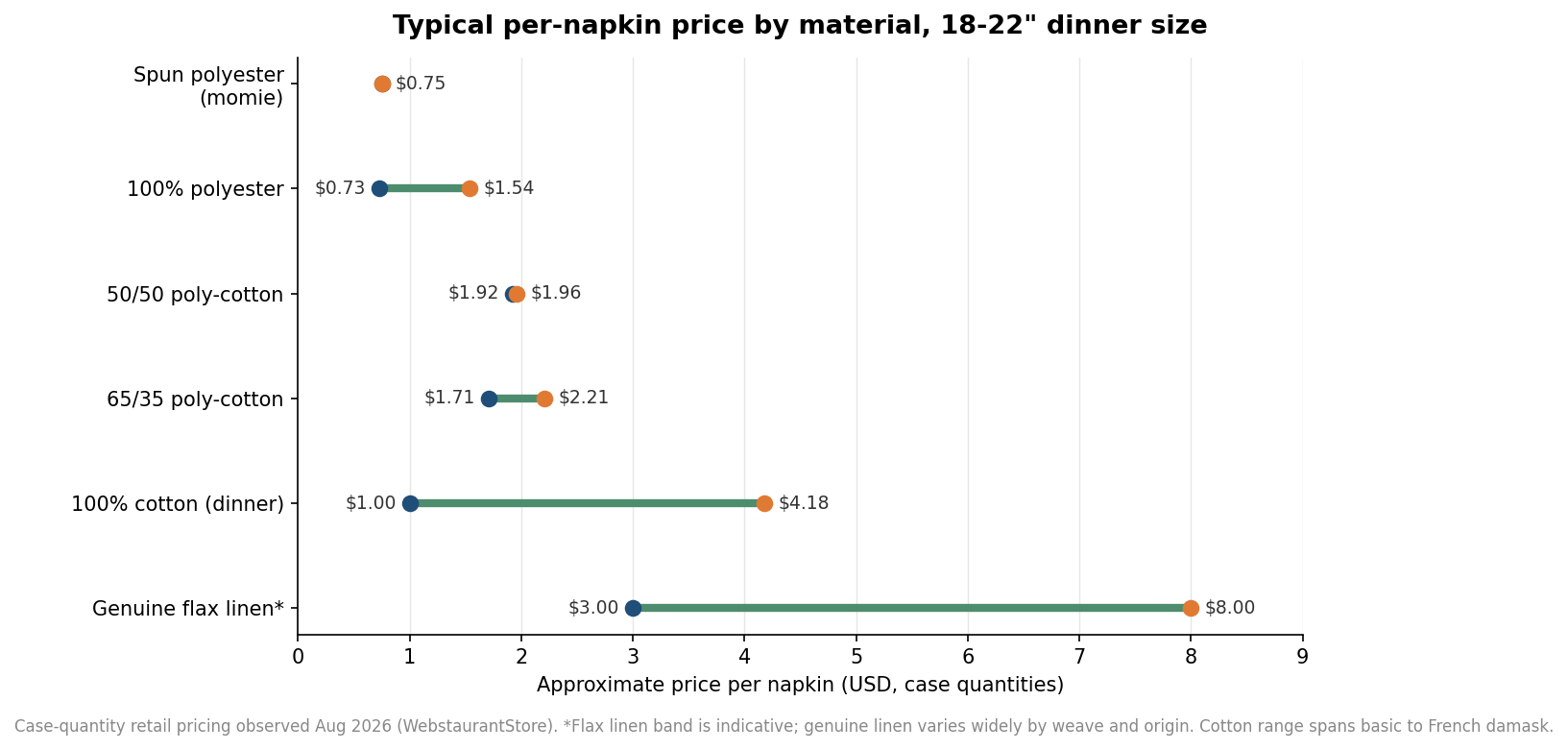
Put the two variables together and a clear pattern emerges. For a casual, high-volume room where napkins turn over fast and get laundered hard, spun or woven polyester in the $0.73-$1.54 range gives you the lowest cost of ownership. For a full-service restaurant that wants a natural feel without a heavy pressing bill, a mid-weight cotton or a 65/35 blend around $1.70-$2.20 is the sensible center of the market. For fine dining, weddings, and any table where the first impression is part of the product, genuine flax linen or a heavyweight French cotton earns its place at the top of the range, indicatively $3-$8 per napkin depending on weave and origin. Those figures are case-quantity retail prices observed in mid-2026 and will move with cotton and freight costs, so treat them as bands rather than quotes.
One practical closing note: whatever fabric you choose, buy enough to run a proper par level. A common rule of thumb is holding roughly 3.5 to 4 times your peak daily use so napkins have time to rest between wash cycles, which itself extends fabric life. The fabric decision sets the ceiling on how good your napkins can look and how long they last; par stock decides whether you actually reach that ceiling.