A napkin is a small canvas, but the way you put a logo or monogram on it changes almost everything downstream: what it costs, how few you can order, how it survives a hundred trips through a commercial washer, and even which fabric you are allowed to choose. There are four methods worth knowing, and they split cleanly into two families — marks that sit on top of the cloth and marks that are built into it. Understanding that split is the fastest way to pick the right one.
Four ways to get a mark onto cloth
The distinction that matters most is surface versus structural. Screen and pad printing lay ink on top of the weave, so the mark is a coating that has to hold on through repeated washing. Dye sublimation converts a design into gas that bonds with polyester fibers, so the color lives inside the fiber rather than on it. Embroidery stitches thread through the cloth, making the mark a physical part of the textile. And woven damask forms the design on the loom, so the pattern is the fabric itself. As a rule, the deeper the mark lives in the cloth, the longer it lasts and the more it costs to set up.
Embroidery: durable, tactile, and made for logos, not photographs
Embroidery is the default for hospitality branding because stitched thread shrugs off the hot water, high-alkaline detergent, and mechanical agitation of a commercial laundry far better than any surface ink. It also reads as premium: the raised texture and slight sheen signal that someone spent money on the linen. The trade-offs are about detail and cost. Embroidery renders clean logos, crests, and monograms beautifully but cannot reproduce gradients or photographic art, and because price scales with stitch count, a dense one-inch crest costs more than a simple two-letter monogram.
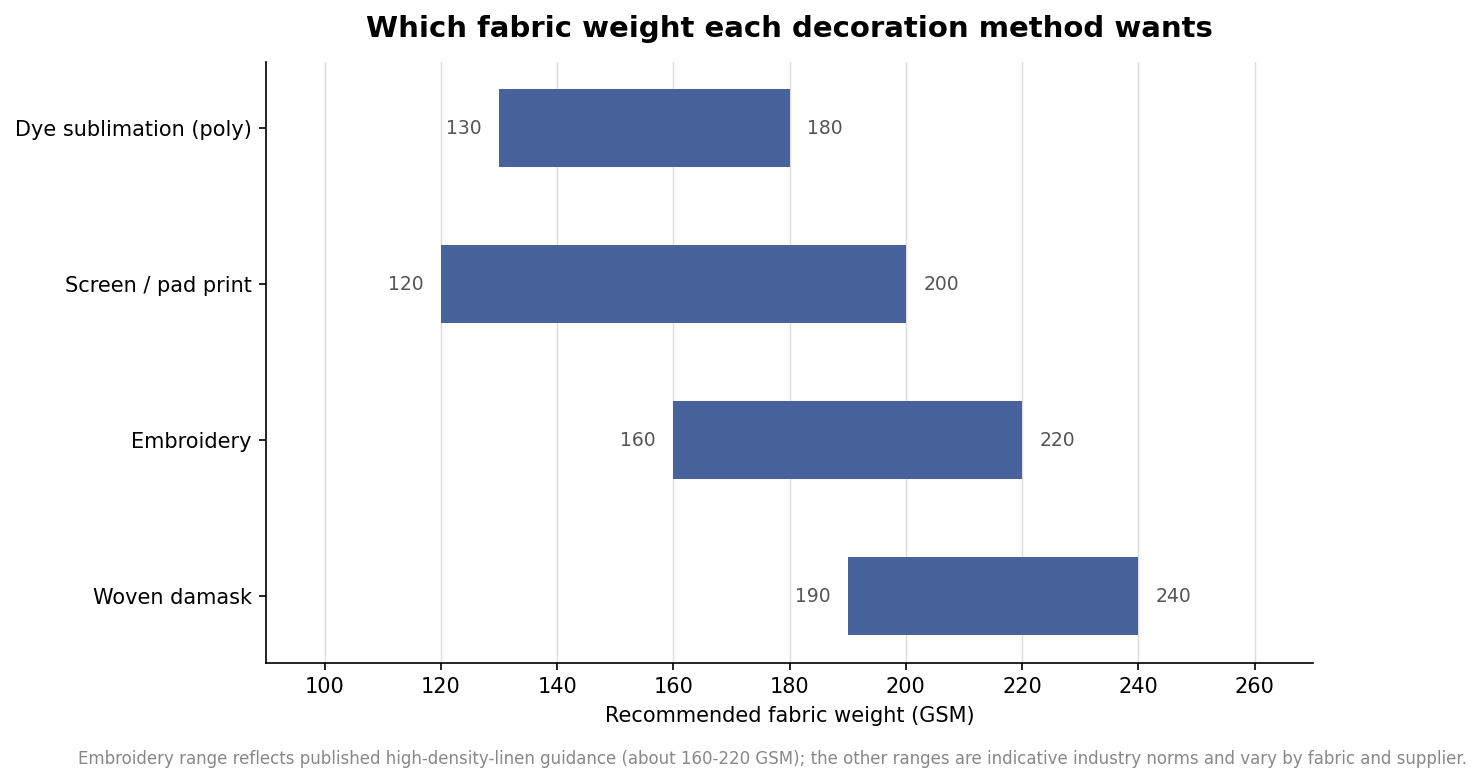
Fabric choice is not optional here. Published guidance for embroidered linen points to dense weaves in roughly the 160 to 220 GSM range, where the fibers do not slip under the needle and multi-color designs stay in registration. Pre-shrunk cloth matters too; a fabric that shrinks only about two percent in both directions keeps the stitching aligned after the first few washes instead of puckering. If you are branding cocktail napkins, monogram placement is usually sized to the napkin, with common finished squares running from about six by six up to ten by ten inches.
Woven damask and satin bands: the mark is the cloth
Woven decoration moves the design into the structure of the textile. In a damask or jacquard weave, the loom itself forms the pattern, so there is nothing on the surface to crack, peel, or fade — the logo lasts exactly as long as the napkin does, which is why grand hotels and banquet halls have used woven crests for generations. The limitations are color and commitment. Woven designs are typically tone-on-tone or one to two colors, and standing up a loom setup means high setup cost and high minimums, so weaving only pays off across large, stable orders.
A satin band is the lighter-weight cousin: a woven satin stripe run near the hem, often in the same color as the napkin for a subtle, tailored cue rather than a loud logo. It is a common way to signal a house style without the cost of a full jacquard, and it pairs well with a small embroidered monogram in the corner when you want both a branded border and a readable mark.
Printing: screen, pad, and dye sublimation
Screen and pad printing are the value options for a bold logo. They handle solid one- to six-color artwork economically, especially at volume, and the setup is cheaper than a loom or a heavy digitized embroidery file. The honest caveat is durability: because the ink sits on the surface, it can crack or soften over many industrial wash cycles, so surface print suits event and promotional napkins better than napkins facing years of daily laundering.
Dye sublimation is the method to reach for when you need full color or a photographic design. Heat transfers the dye directly into polyester fibers, producing a result that is colorfast and machine washable warm, with no coating to wear off. The single hard constraint is fabric: sublimation only bonds to polyester or high-polyester blends, so it is off the table for genuine cotton or flax linen. Sublimated napkins are commonly sold in small increments — often batches of twelve — on full-size dinner squares around twenty by twenty inches, and can be printed on a single side, leaving the reverse white, or on both sides for an added charge.
Order size, fabric, and how to choose
Start with the two constraints that eliminate options fastest: how many you can order, and what fabric you actually want. Minimum order varies enormously by method, and it usually tracks how much fixed setup each one requires. The chart below shows the rough order of magnitude — small for sublimation, larger as you move toward a woven program.
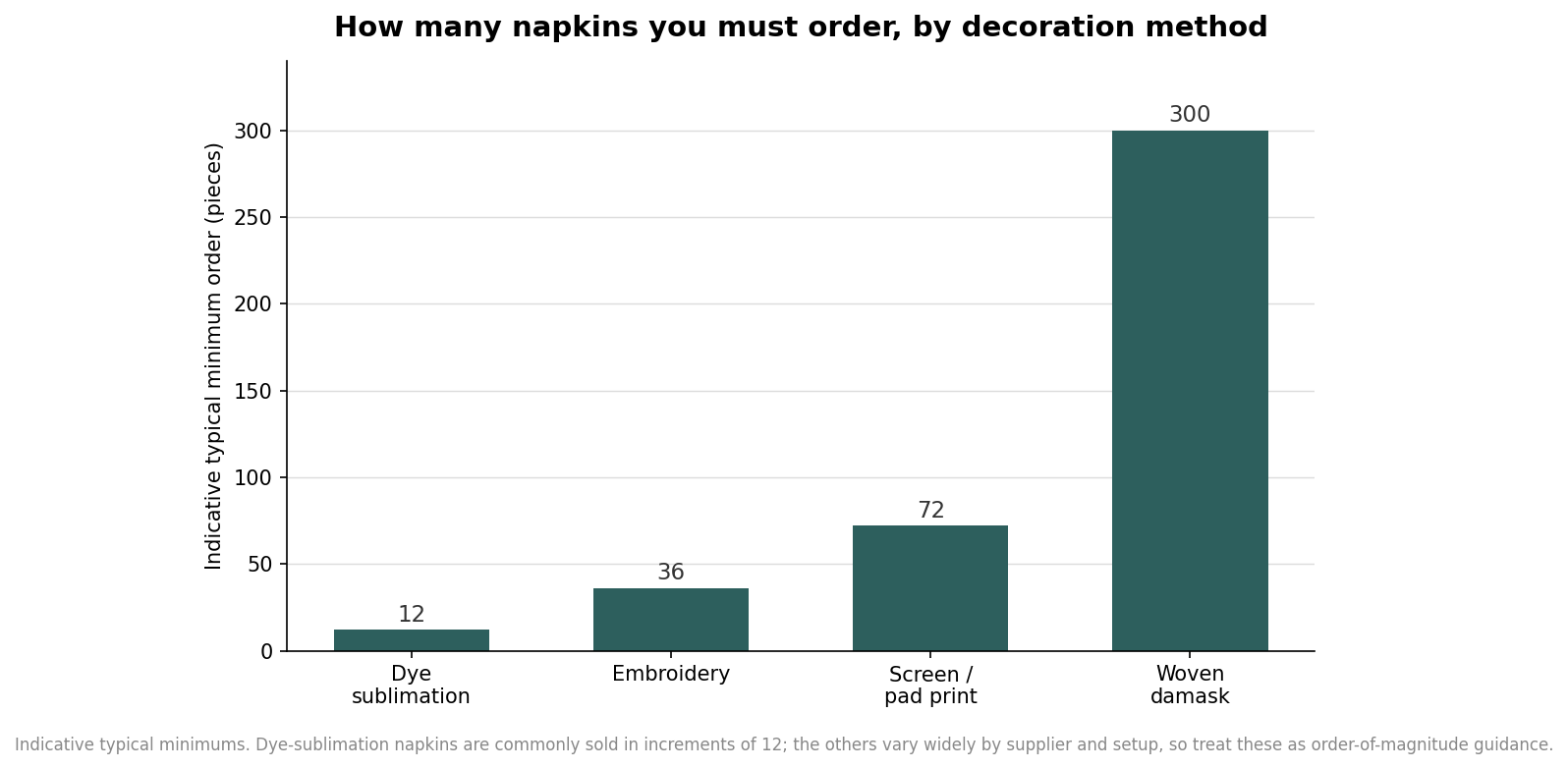
Then check that your fabric and your method agree. Sublimation demands polyester; embroidery and weaving reward a heavier, denser cloth; surface printing is the most forgiving across weights. The range chart below sketches where each method sits, with the embroidery band reflecting the published high-density-linen guidance and the rest shown as indicative norms.
From there the decision is short. If you run genuine linen or cotton and expect years of commercial laundering, embroidery or a woven treatment will outlast everything else and look the part. If you need full-color art or you are printing polyester for events, sublimation wins on color and low minimums. If you want a bold, simple logo at the lowest price and the napkins will not be washed hundreds of times, screen print earns its place. Whichever you choose, ask for a decorated sample on your actual fabric and run it through your real wash cycle a few times before you commit to the full run — the laundry, not the proof, is the true test of any napkin mark.