Ask three sources for the “standard” cloth napkin size and you will get three answers, because napkin sizing is organized around service, not a single number. A cocktail napkin and a formal dinner napkin are both correct; they are simply built for different jobs. Choosing well means matching the finished square to how the napkin is used at the table, then ordering enough fabric to reach that size after hemming. This guide walks the common sizes by service and shows where the ranges overlap, so a custom order lands right the first time.
The four sizes that cover almost every table
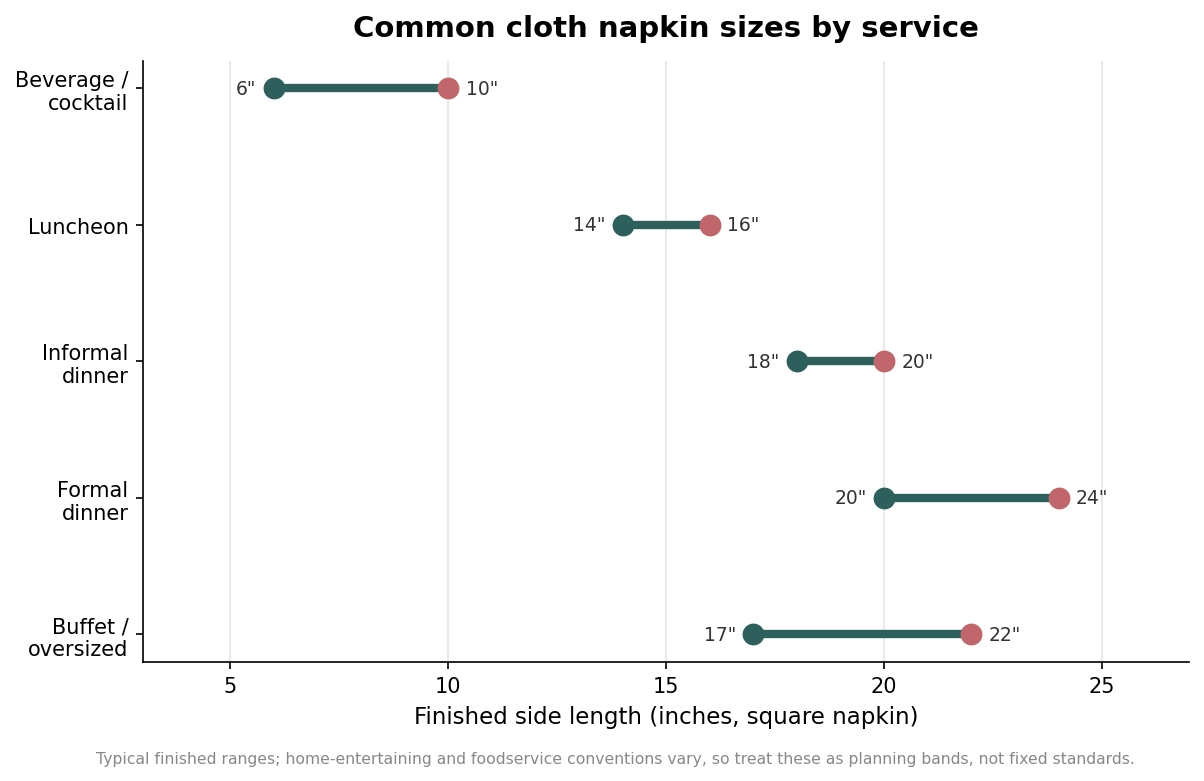
Most real-world needs fall into four buckets: beverage, luncheon, dinner, and formal. Beverage or cocktail napkins are the smallest, generally six to ten inches square, and often sold folded to about five inches. Luncheon napkins sit at roughly fourteen to sixteen inches. Everyday dinner napkins land around eighteen to twenty inches, and formal dinner napkins run larger, commonly twenty to twenty-four inches and occasionally up to twenty-six. A fifth category, the buffet or oversized napkin, overlaps the top of that range at seventeen to twenty-two inches and is chosen for its double duty as a lap cover.
These are planning bands rather than fixed rules, and two conventions pull them in different directions. Home and event sources tend to describe napkins by occasion, while foodservice suppliers standardize on a few workhorse dimensions, most often 20 by 20 inches for dinner service and 16 by 16 or 18 by 18 for lunch. When in doubt, the size that reads as neither cramped nor theatrical for your setting is usually the right one.
Beverage and cocktail napkins: small on purpose
A beverage napkin is meant to be held, not spread across a lap. At six to ten inches, it wraps a glass, catches condensation, or cradles a single passed bite without bunching in the hand. For standing receptions and bar service this smaller square is the point: it looks tidy, uses the least fabric per unit, and stacks compactly at a busy station. If guests will be seated and eating with utensils, this size is too small, so reserve it for drinks and finger food.
Because these napkins are so visible up close, decoration reads strongly on them. A discreet monogram or a single embroidered mark occupies a large share of a small square, which is why cocktail napkins are a common place to carry a venue’s identity. Keep any print small and away from the folded edges so it survives the fold rather than disappearing into it.
Luncheon and everyday dinner: the versatile middle
The middle of the range, roughly sixteen to twenty inches, is where a single size can serve most of the week. A sixteen-inch luncheon napkin suits brunches, tea service, and lighter plates where a full dinner napkin would feel oversized. Move up to eighteen or twenty inches and the same napkin covers a lap comfortably through a full meal, which is why casual and mid-tier restaurants often standardize here. If you are buying one size to cover mixed service, an eighteen-inch square is the safest single choice.
Fabric weight matters as much as dimension in this band. A lighter napkin at twenty inches can feel flimsy, while a heavier weave at sixteen inches can feel substantial, so consider hand and drape alongside the measurement. The size sets the coverage; the cloth sets the impression, and the two decisions should be made together rather than in sequence.
Formal and buffet: when bigger earns its keep
Formal dinner napkins are larger because a multi-course meal asks more of them. At twenty-two to twenty-six inches, a napkin drapes fully across the lap, holds an elaborate fold without collapsing, and frames a place setting with visible generosity. This is the size for weddings, banquets, and tasting menus, where the napkin is part of the tablescape and not just a utility. The cost is real, since larger squares use more fabric and more laundering capacity, so scale the size to the occasion rather than defaulting to the biggest option.
Buffet napkins occupy adjacent territory for a different reason. At seventeen to twenty-two inches they double as a lap cover and a light placemat for guests eating away from a set table, which is exactly the situation a buffet or outdoor gathering creates. If your service has people balancing plates on their knees, the buffet size buys coverage that a luncheon napkin cannot.
Order the cut size, not just the finished number
The size a guest sees is the finished size, after hemming, and that is not the size you cut. A standard double-fold hem consumes roughly an inch per side, so a twenty-inch finished napkin typically starts from a cut of about twenty-two inches square, and a heavier or wider hem takes a little more. Washing adds another variable, because natural fibers such as cotton and flax linen can shrink on their first laundering, which is one reason many makers cut with extra margin and pre-wash where possible. Treat the exact allowance as indicative and confirm it against the specific fabric and hem style.
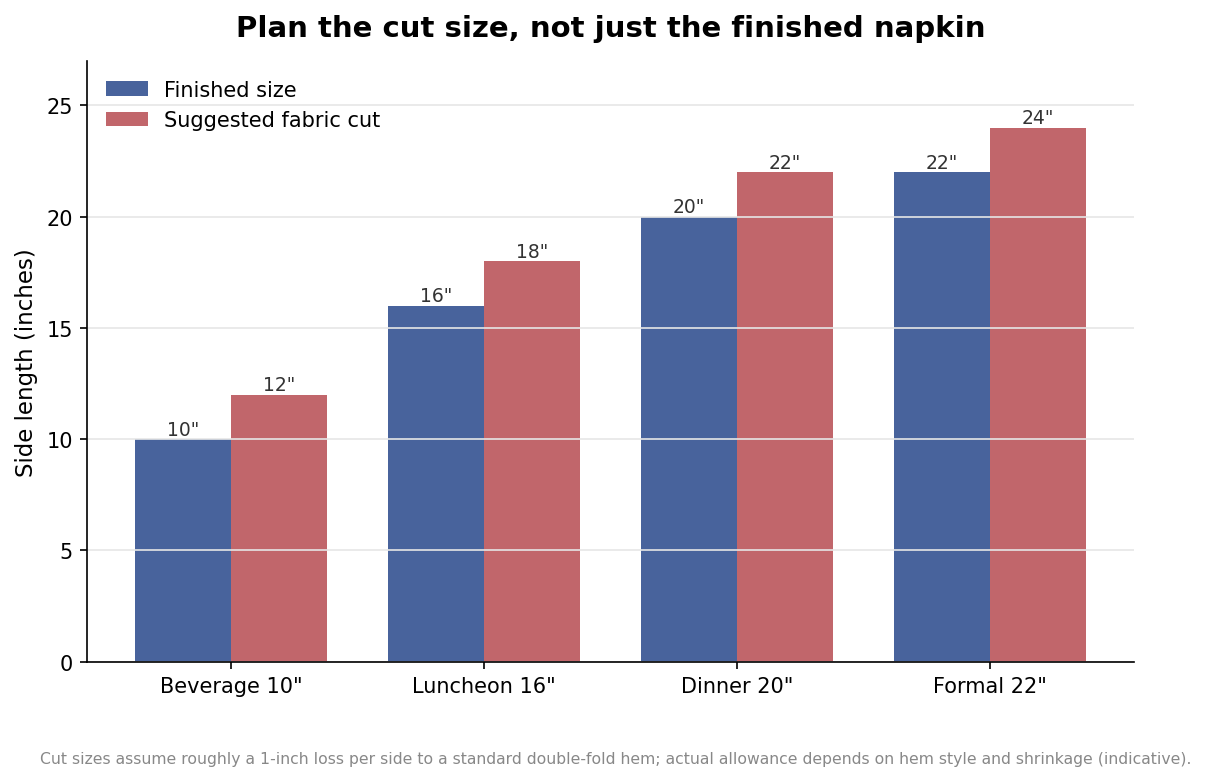
For a custom order, the clean way to specify is to state the finished square you want, the hem style, and the fabric, and let the maker calculate the cut. That keeps the number your guests experience fixed while the production math flexes around shrinkage and hem type. Get the finished size right for your service, add the allowance the fabric demands, and the napkins arrive at the dimension you actually planned for rather than an inch shy of it.