Category: Uncategorized

  • How to Put a Logo on Napkins: Embroidery, Weaving, and Printing Compared

    How to Put a Logo on Napkins: Embroidery, Weaving, and Printing Compared

    A napkin is a small canvas, but the way you put a logo or monogram on it changes almost everything downstream: what it costs, how few you can order, how it survives a hundred trips through a commercial washer, and even which fabric you are allowed to choose. There are four methods worth knowing, and they split cleanly into two families — marks that sit on top of the cloth and marks that are built into it. Understanding that split is the fastest way to pick the right one.

    Four ways to get a mark onto cloth

    The distinction that matters most is surface versus structural. Screen and pad printing lay ink on top of the weave, so the mark is a coating that has to hold on through repeated washing. Dye sublimation converts a design into gas that bonds with polyester fibers, so the color lives inside the fiber rather than on it. Embroidery stitches thread through the cloth, making the mark a physical part of the textile. And woven damask forms the design on the loom, so the pattern is the fabric itself. As a rule, the deeper the mark lives in the cloth, the longer it lasts and the more it costs to set up.

    Embroidery: durable, tactile, and made for logos, not photographs

    Embroidery is the default for hospitality branding because stitched thread shrugs off the hot water, high-alkaline detergent, and mechanical agitation of a commercial laundry far better than any surface ink. It also reads as premium: the raised texture and slight sheen signal that someone spent money on the linen. The trade-offs are about detail and cost. Embroidery renders clean logos, crests, and monograms beautifully but cannot reproduce gradients or photographic art, and because price scales with stitch count, a dense one-inch crest costs more than a simple two-letter monogram.

    Fabric choice is not optional here. Published guidance for embroidered linen points to dense weaves in roughly the 160 to 220 GSM range, where the fibers do not slip under the needle and multi-color designs stay in registration. Pre-shrunk cloth matters too; a fabric that shrinks only about two percent in both directions keeps the stitching aligned after the first few washes instead of puckering. If you are branding cocktail napkins, monogram placement is usually sized to the napkin, with common finished squares running from about six by six up to ten by ten inches.

    Woven damask and satin bands: the mark is the cloth

    Woven decoration moves the design into the structure of the textile. In a damask or jacquard weave, the loom itself forms the pattern, so there is nothing on the surface to crack, peel, or fade — the logo lasts exactly as long as the napkin does, which is why grand hotels and banquet halls have used woven crests for generations. The limitations are color and commitment. Woven designs are typically tone-on-tone or one to two colors, and standing up a loom setup means high setup cost and high minimums, so weaving only pays off across large, stable orders.

    A satin band is the lighter-weight cousin: a woven satin stripe run near the hem, often in the same color as the napkin for a subtle, tailored cue rather than a loud logo. It is a common way to signal a house style without the cost of a full jacquard, and it pairs well with a small embroidered monogram in the corner when you want both a branded border and a readable mark.

    Printing: screen, pad, and dye sublimation

    Screen and pad printing are the value options for a bold logo. They handle solid one- to six-color artwork economically, especially at volume, and the setup is cheaper than a loom or a heavy digitized embroidery file. The honest caveat is durability: because the ink sits on the surface, it can crack or soften over many industrial wash cycles, so surface print suits event and promotional napkins better than napkins facing years of daily laundering.

    Dye sublimation is the method to reach for when you need full color or a photographic design. Heat transfers the dye directly into polyester fibers, producing a result that is colorfast and machine washable warm, with no coating to wear off. The single hard constraint is fabric: sublimation only bonds to polyester or high-polyester blends, so it is off the table for genuine cotton or flax linen. Sublimated napkins are commonly sold in small increments — often batches of twelve — on full-size dinner squares around twenty by twenty inches, and can be printed on a single side, leaving the reverse white, or on both sides for an added charge.

    Order size, fabric, and how to choose

    Start with the two constraints that eliminate options fastest: how many you can order, and what fabric you actually want. Minimum order varies enormously by method, and it usually tracks how much fixed setup each one requires. The chart below shows the rough order of magnitude — small for sublimation, larger as you move toward a woven program.
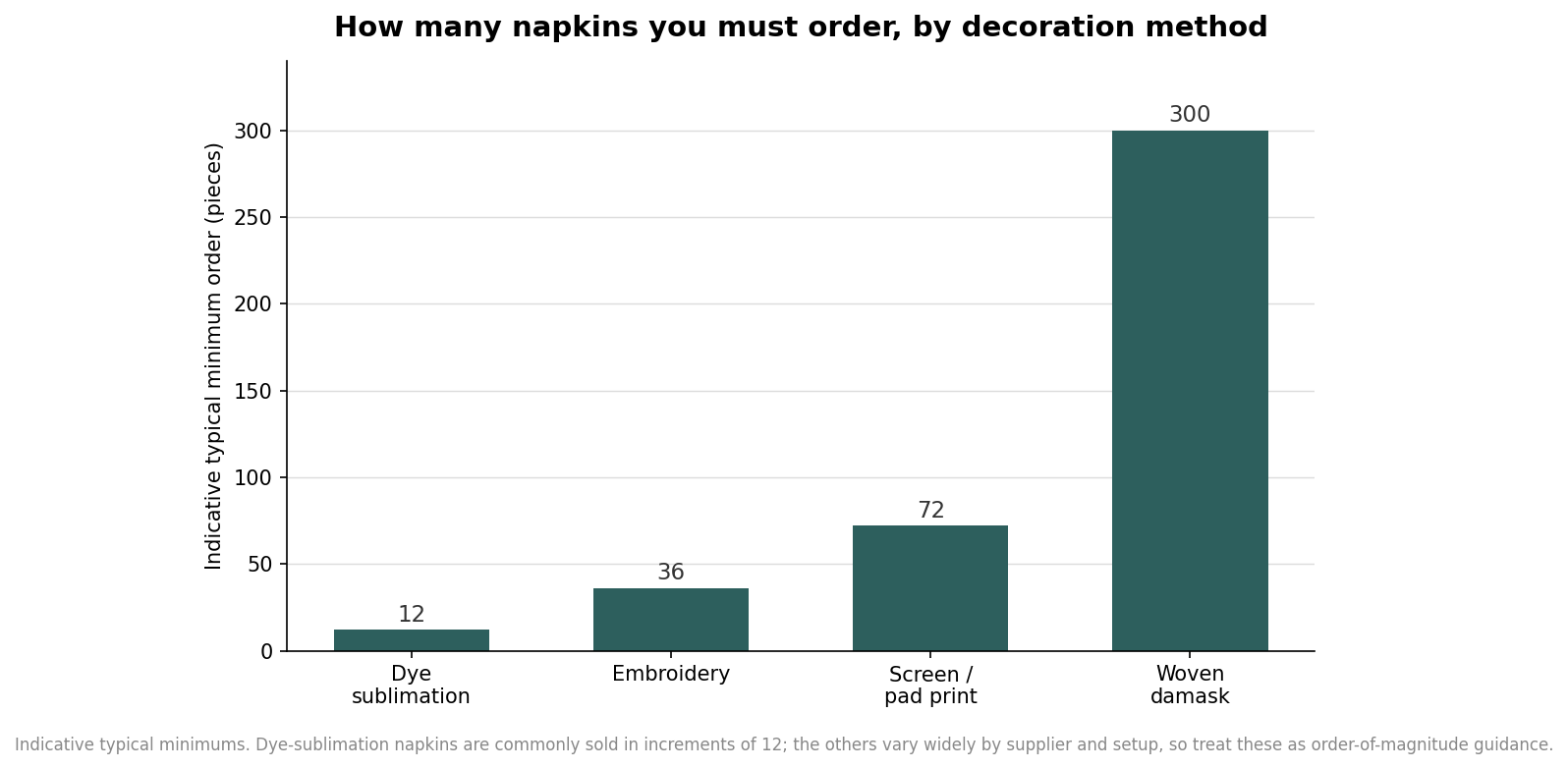
    Bar chart of indicative typical minimum order quantities by napkin decoration method, from dye sublimation at twelve to woven damask at three hundred
    Indicative minimum order by method: sublimation orders can be tiny, while a woven program needs volume to justify the loom setup.

    Then check that your fabric and your method agree. Sublimation demands polyester; embroidery and weaving reward a heavier, denser cloth; surface printing is the most forgiving across weights. The range chart below sketches where each method sits, with the embroidery band reflecting the published high-density-linen guidance and the rest shown as indicative norms.
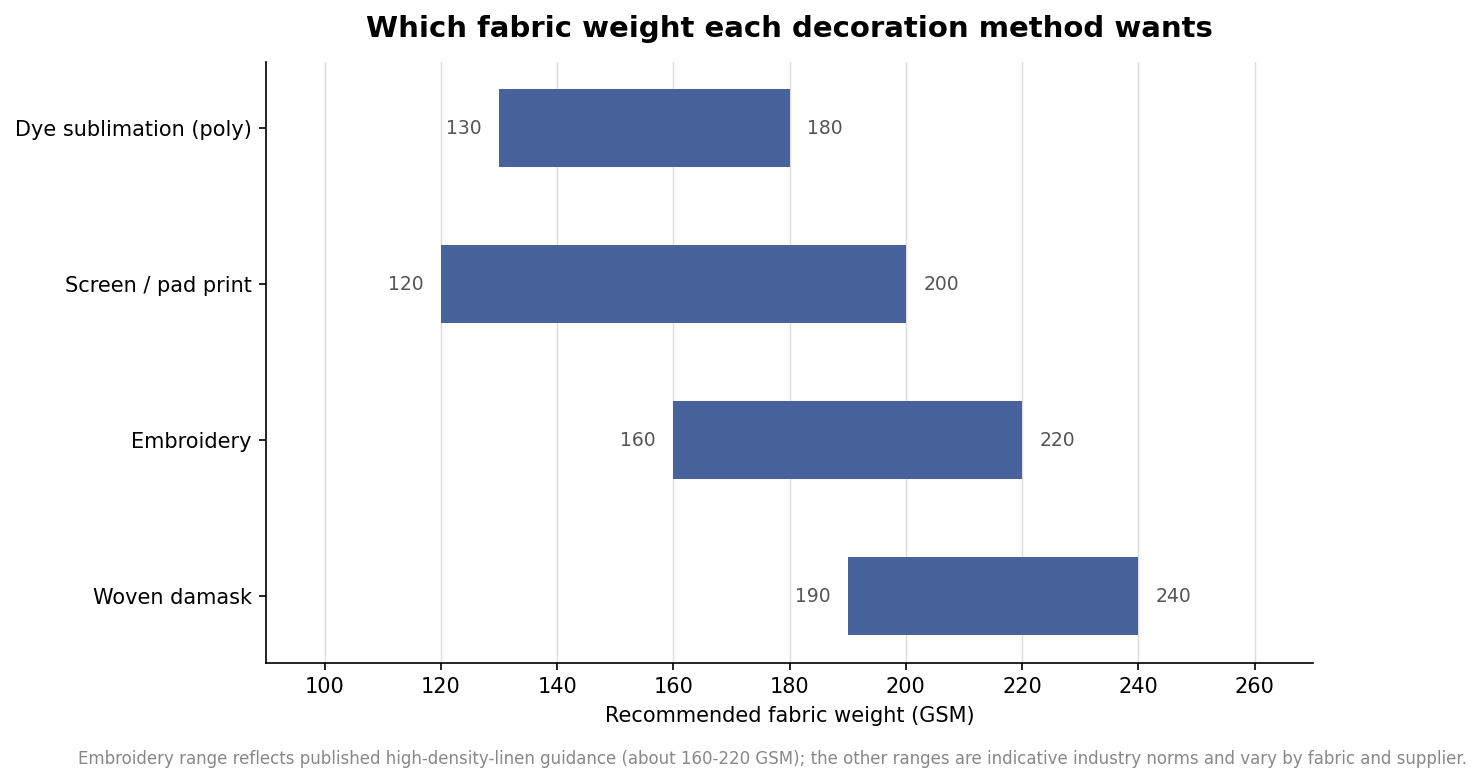
    Range bar chart of recommended fabric weight in GSM for each decoration method, with embroidery around 160 to 220 GSM
    Each method wants a fabric weight window; sublimation also requires polyester, ruling it out for genuine cotton or linen.

    From there the decision is short. If you run genuine linen or cotton and expect years of commercial laundering, embroidery or a woven treatment will outlast everything else and look the part. If you need full-color art or you are printing polyester for events, sublimation wins on color and low minimums. If you want a bold, simple logo at the lowest price and the napkins will not be washed hundreds of times, screen print earns its place. Whichever you choose, ask for a decorated sample on your actual fabric and run it through your real wash cycle a few times before you commit to the full run — the laundry, not the proof, is the true test of any napkin mark.
  • Linen, Cotton, or Polyester Napkins: A Fabric Deep-Dive for Buyers

    Linen, Cotton, or Polyester Napkins: A Fabric Deep-Dive for Buyers

    Fabric is the single decision that shapes how a napkin feels in a guest’s hand, how it launders over a year of service, and what it costs to keep a full par stock on the shelf. Size and hemming matter, but they are refinements on top of the material choice. This guide walks through the fabrics used for custom napkins, what each one actually does at the table and in the wash, and how weight and price track with service level so you can specify with confidence.

    What the fabric actually changes

    Three properties separate one napkin fabric from another: absorbency, wrinkle behavior, and how the material ages through repeated laundering. Absorbency governs whether the napkin does its job during a meal. Wrinkle behavior decides how much pressing labor a linen program adds. And aging determines your real cost of ownership, because a napkin that thins or grays after a hundred washes is more expensive at $1.50 than a napkin that survives several hundred washes at $3. A common industry durability claim is around 500 wash cycles, but in practice many mid-weight cottons show visible wear closer to 100 washes, while genuine flax linen tends to soften and improve rather than degrade. Keep that gap in mind whenever a spec sheet quotes a single headline number.

    Genuine flax linen, the premium performer

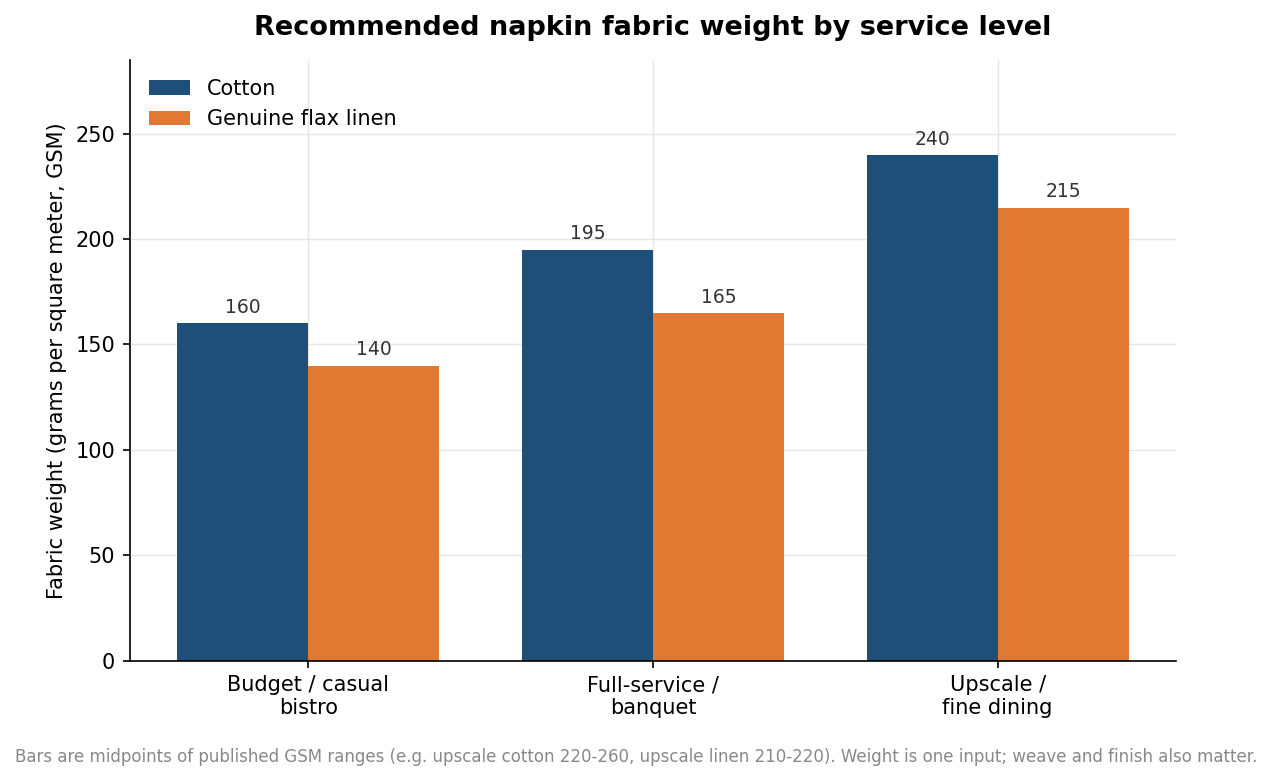
    Real flax linen has a natural slub texture and a hand that reads as upscale the moment a guest picks it up. It is highly absorbent, it becomes softer with each wash because of the natural pectin in the fiber, and it carries the strongest sustainability story of the common options. The trade-offs are wrinkle and price. Linen creases readily, so a linen program needs pressing or a deliberately relaxed, folded presentation. On weight, linen runs a little lighter than cotton for the same service level: roughly 130-150 GSM for casual use, 160-170 GSM for full service, and 210-220 GSM for fine dining. Genuine flax also sits at the top of the price band, which is why it is usually reserved for the tables where the tactile impression justifies the cost.

    Grouped bar chart of recommended cotton and linen napkin weight in GSM across casual, full-service, and fine-dining tiers
    Cotton runs slightly heavier than linen at every service level; bars show midpoints of published GSM ranges.

    Cotton and poly-cotton, the workhorses

    Cotton is the most common napkin fiber in North American hospitality for good reason: it is soft, genuinely absorbent, takes a press well, and spans an enormous quality range. Entry-weight cotton around 150-170 GSM suits bistros, while steakhouse and banquet cotton climbs to 220-260 GSM for a substantial drape. The catch is upkeep. Cotton wrinkles, needs ironing to look crisp, and the cheaper grades are the ones most likely to thin early. Poly-cotton blends, typically 65/35 or 50/50, trade some absorbency for wrinkle resistance and a lower laundering burden. They are the pragmatic middle: more forgiving than pure cotton in a busy laundry cycle, more breathable and natural-feeling than pure polyester. If your staff presses napkins by hand, a blend can pay for itself in labor even though the fabric costs a little more per piece.

    Polyester and spun polyester, durability and cost

    Polyester is built for volume. It is wrinkle-resistant, holds its shape through aggressive commercial laundering, and resists staining better than natural fibers, which is why high-turnover venues and event rental inventories lean on it. Standard woven polyester feels the least natural of the group, but spun polyester (often sold as momie or visa) is spun rather than filament, which gives it a softer, more cotton-like hand while keeping polyester’s toughness. On cost it is the value leader, frequently the cheapest durable option per napkin. The honest downside is absorbency: polyester moves moisture around more than it soaks it up, so it is a weaker choice where the napkin needs to handle a genuinely wet, sauce-heavy meal.

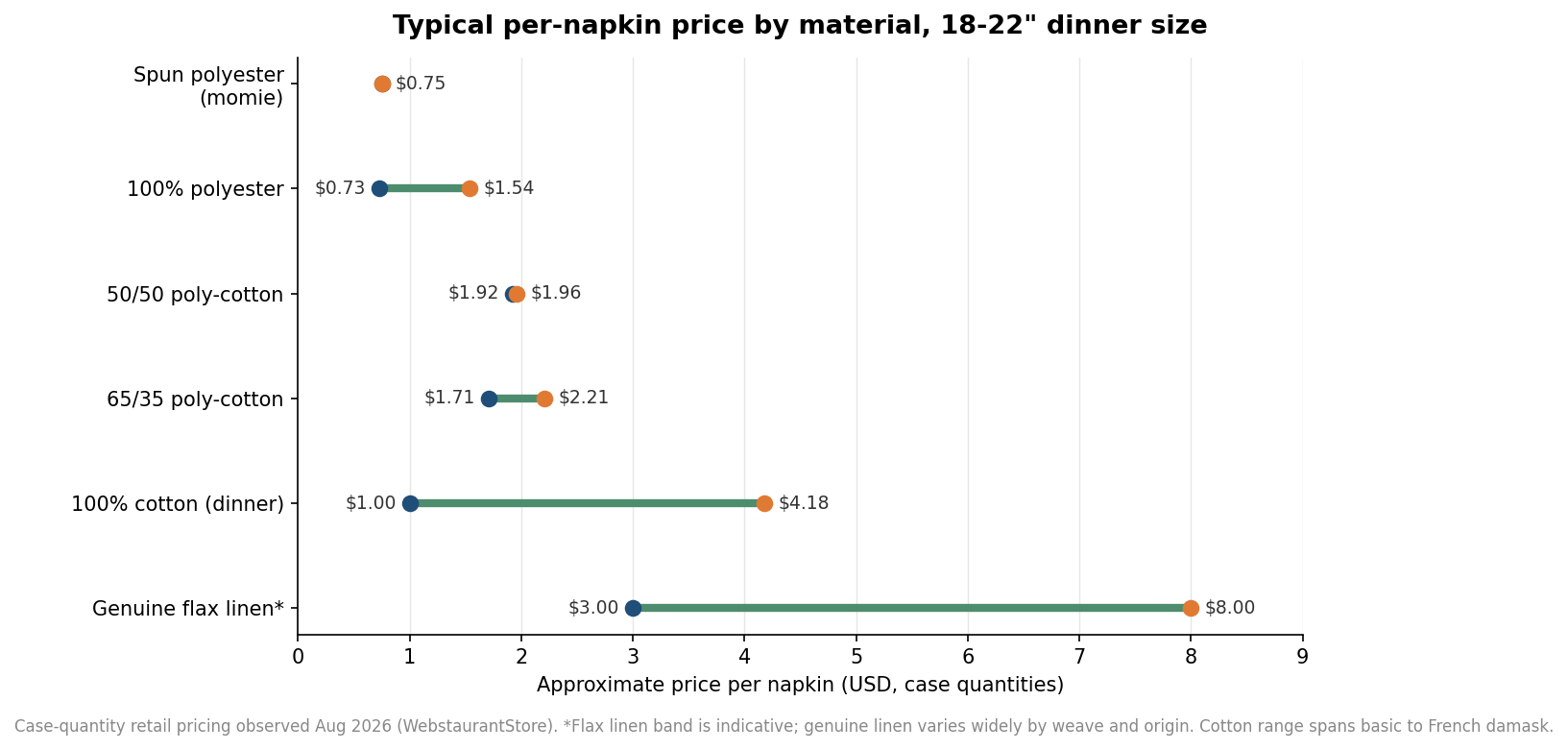
    Range plot of typical per-napkin price by material from spun polyester through genuine flax linen
    Per-napkin price bands by material in case quantities; polyester leads on cost, genuine linen sits at the top.

    Weave and finish, the detail beyond fiber

    Fiber sets the character, but weave decides the surface. A plain weave is the everyday construction: even, durable, and easy to launder. Twill adds a subtle diagonal rib that hides light soiling and drapes with a bit more body, which is part of why it shows up in heavier service napkins. Damask is the dressiest of the common weaves, using the contrast between satin-faced and matte areas to work a pattern directly into the cloth rather than printing it on, and it reads as formal without any added color. A satin band or a woven border, meanwhile, is a finish rather than a weave: it frames the napkin and signals care without changing the base fabric. These choices interact with hemming, too. A tightly woven, heavier cloth resists the corner fraying that thinner napkins show first, so specifying a slightly heavier weight or a denser weave often does more for longevity than any single laundering rule. When you compare quotes, make sure you are comparing the same fiber, the same weight, and the same weave, because any one of the three can swing both feel and price.

    Matching weight and budget to the room

    Put the two variables together and a clear pattern emerges. For a casual, high-volume room where napkins turn over fast and get laundered hard, spun or woven polyester in the $0.73-$1.54 range gives you the lowest cost of ownership. For a full-service restaurant that wants a natural feel without a heavy pressing bill, a mid-weight cotton or a 65/35 blend around $1.70-$2.20 is the sensible center of the market. For fine dining, weddings, and any table where the first impression is part of the product, genuine flax linen or a heavyweight French cotton earns its place at the top of the range, indicatively $3-$8 per napkin depending on weave and origin. Those figures are case-quantity retail prices observed in mid-2026 and will move with cotton and freight costs, so treat them as bands rather than quotes.

    One practical closing note: whatever fabric you choose, buy enough to run a proper par level. A common rule of thumb is holding roughly 3.5 to 4 times your peak daily use so napkins have time to rest between wash cycles, which itself extends fabric life. The fabric decision sets the ceiling on how good your napkins can look and how long they last; par stock decides whether you actually reach that ceiling.

  • Standard Cloth Napkin Sizes, and How to Choose by Service

    Standard Cloth Napkin Sizes, and How to Choose by Service

    Ask three sources for the “standard” cloth napkin size and you will get three answers, because napkin sizing is organized around service, not a single number. A cocktail napkin and a formal dinner napkin are both correct; they are simply built for different jobs. Choosing well means matching the finished square to how the napkin is used at the table, then ordering enough fabric to reach that size after hemming. This guide walks the common sizes by service and shows where the ranges overlap, so a custom order lands right the first time.

    The four sizes that cover almost every table

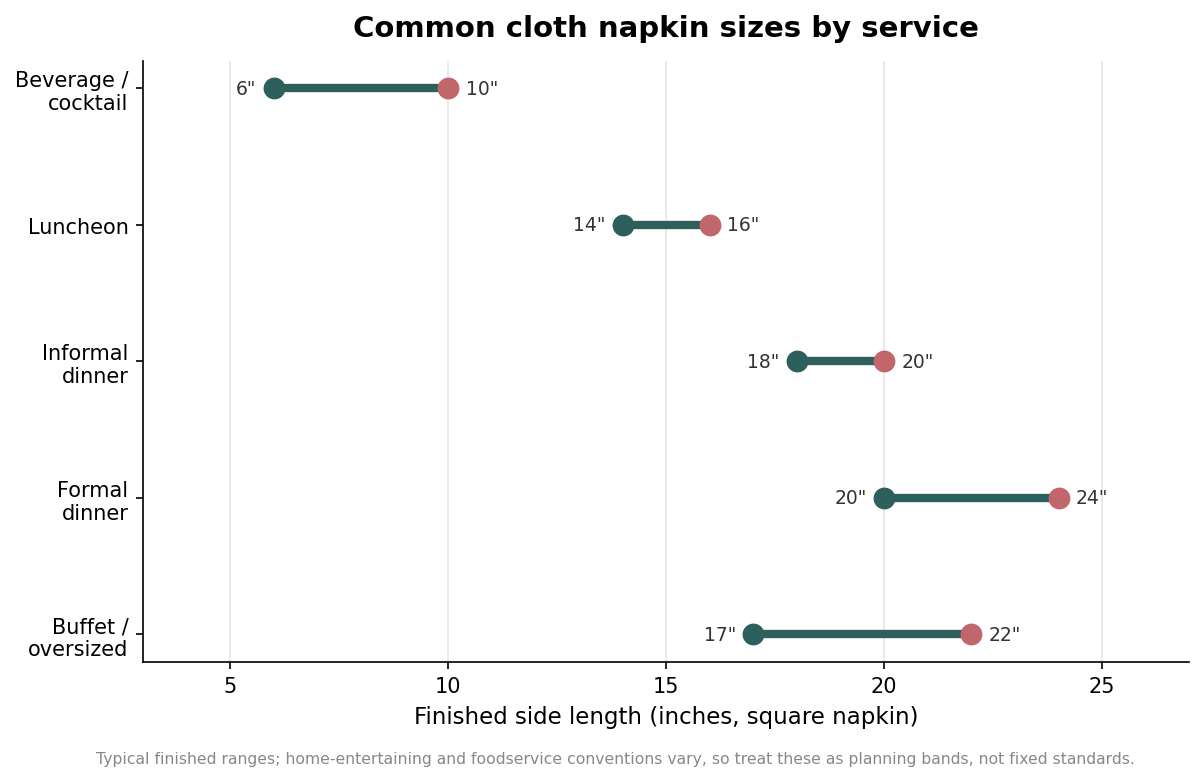
    Most real-world needs fall into four buckets: beverage, luncheon, dinner, and formal. Beverage or cocktail napkins are the smallest, generally six to ten inches square, and often sold folded to about five inches. Luncheon napkins sit at roughly fourteen to sixteen inches. Everyday dinner napkins land around eighteen to twenty inches, and formal dinner napkins run larger, commonly twenty to twenty-four inches and occasionally up to twenty-six. A fifth category, the buffet or oversized napkin, overlaps the top of that range at seventeen to twenty-two inches and is chosen for its double duty as a lap cover.

    These are planning bands rather than fixed rules, and two conventions pull them in different directions. Home and event sources tend to describe napkins by occasion, while foodservice suppliers standardize on a few workhorse dimensions, most often 20 by 20 inches for dinner service and 16 by 16 or 18 by 18 for lunch. When in doubt, the size that reads as neither cramped nor theatrical for your setting is usually the right one.

    Range chart of common cloth napkin finished sizes in inches for beverage, luncheon, dinner, formal, and buffet service
    Typical finished size bands by service; conventions vary between home and foodservice use.

    Beverage and cocktail napkins: small on purpose

    A beverage napkin is meant to be held, not spread across a lap. At six to ten inches, it wraps a glass, catches condensation, or cradles a single passed bite without bunching in the hand. For standing receptions and bar service this smaller square is the point: it looks tidy, uses the least fabric per unit, and stacks compactly at a busy station. If guests will be seated and eating with utensils, this size is too small, so reserve it for drinks and finger food.

    Because these napkins are so visible up close, decoration reads strongly on them. A discreet monogram or a single embroidered mark occupies a large share of a small square, which is why cocktail napkins are a common place to carry a venue’s identity. Keep any print small and away from the folded edges so it survives the fold rather than disappearing into it.

    Luncheon and everyday dinner: the versatile middle

    The middle of the range, roughly sixteen to twenty inches, is where a single size can serve most of the week. A sixteen-inch luncheon napkin suits brunches, tea service, and lighter plates where a full dinner napkin would feel oversized. Move up to eighteen or twenty inches and the same napkin covers a lap comfortably through a full meal, which is why casual and mid-tier restaurants often standardize here. If you are buying one size to cover mixed service, an eighteen-inch square is the safest single choice.

    Fabric weight matters as much as dimension in this band. A lighter napkin at twenty inches can feel flimsy, while a heavier weave at sixteen inches can feel substantial, so consider hand and drape alongside the measurement. The size sets the coverage; the cloth sets the impression, and the two decisions should be made together rather than in sequence.

    Formal and buffet: when bigger earns its keep

    Formal dinner napkins are larger because a multi-course meal asks more of them. At twenty-two to twenty-six inches, a napkin drapes fully across the lap, holds an elaborate fold without collapsing, and frames a place setting with visible generosity. This is the size for weddings, banquets, and tasting menus, where the napkin is part of the tablescape and not just a utility. The cost is real, since larger squares use more fabric and more laundering capacity, so scale the size to the occasion rather than defaulting to the biggest option.

    Buffet napkins occupy adjacent territory for a different reason. At seventeen to twenty-two inches they double as a lap cover and a light placemat for guests eating away from a set table, which is exactly the situation a buffet or outdoor gathering creates. If your service has people balancing plates on their knees, the buffet size buys coverage that a luncheon napkin cannot.

    Order the cut size, not just the finished number

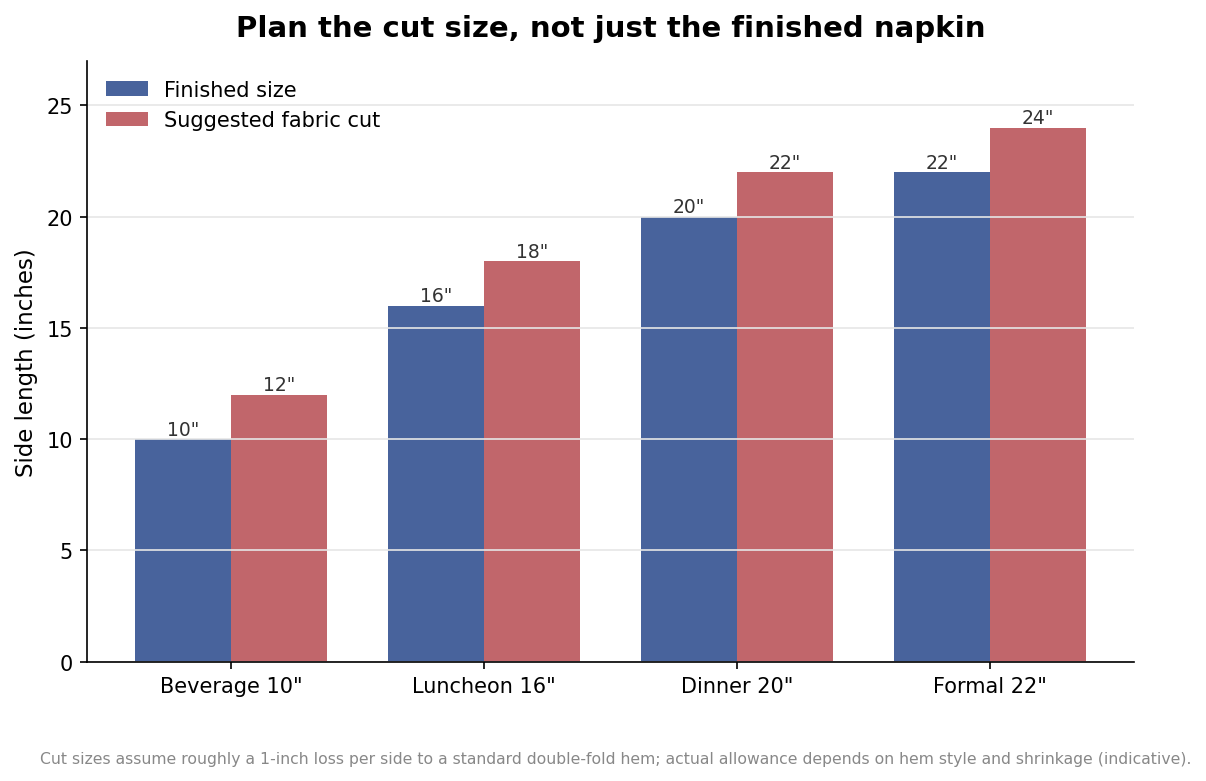
    The size a guest sees is the finished size, after hemming, and that is not the size you cut. A standard double-fold hem consumes roughly an inch per side, so a twenty-inch finished napkin typically starts from a cut of about twenty-two inches square, and a heavier or wider hem takes a little more. Washing adds another variable, because natural fibers such as cotton and flax linen can shrink on their first laundering, which is one reason many makers cut with extra margin and pre-wash where possible. Treat the exact allowance as indicative and confirm it against the specific fabric and hem style.

    Grouped bar chart comparing finished napkin size to suggested fabric cut size for four common napkin sizes
    Finished size versus the larger square you cut to reach it after hemming.

    For a custom order, the clean way to specify is to state the finished square you want, the hem style, and the fabric, and let the maker calculate the cut. That keeps the number your guests experience fixed while the production math flexes around shrinkage and hem type. Get the finished size right for your service, add the allowance the fabric demands, and the napkins arrive at the dimension you actually planned for rather than an inch shy of it.

  • Why Your Napkins Keep Grease Marks

    This is the single most common complaint we hear, and it is almost always blamed on the wrong thing.

    Polyester and oil

    Polyester is hydrophobic: it repels water. It is also oleophilic: oil is attracted to it and bonds with it. Those two properties together are exactly wrong for a napkin, whose whole job is to take watery liquid off skin and then be cleaned of whatever else came with it.

    So a spun polyester napkin is slow to wet out, and once oil is in it, a normal wash cycle will not lift it the way it would from cotton. That is chemistry, not a failure of your laundry.

    Why everybody buys it anyway

    Because the alternative costs labor. Polyester comes out of a tumble dryer flat and ready. Cotton comes out creased and has to be pressed, which means equipment, floor space and staff time in a building that has none of the three going spare.

    For a high-turnover room with no press, the trade is usually still worth making. It should just be made with the facts in hand.

    What actually helps

    Move toward cotton. Even a poly-cotton blend at a cotton-rich split releases oil noticeably better than a hundred percent polyester, and you can often get most of the benefit without moving all the way to pure cotton and a full pressing operation.

    Wash sooner rather than hotter. Oil that has sat in polyester for two days is far harder to shift than oil that goes into the machine the same evening. That is an operational change and it is free.

    What does not help

    Raising the wash temperature indefinitely. Past a point you are shortening the life of the napkin and the embroidery without lifting the oil.

    Stain-release finishes. They are genuinely useful when new and they deplete with every wash. Treat them as a bonus for the first season rather than as the reason you chose the cloth.

    Buying a heavier polyester. Weight is not the variable here. The fiber is.

  • Hems: Why Napkins Fray at the Corner First

    Napkins are rarely retired because of stains. They are retired because the corner went.

    What a serged edge is

    Serging wraps thread around the raw edge of the fabric to stop it unravelling. It is fast, it is cheap and it is genuinely fine on garments that get a domestic wash.

    In an industrial laundry it is not fine. The cloth is agitated hard, spun, and tumbled against hundreds of other items, and all of that load finds the corner. Once a few threads go, the corner unravels and the napkin cannot be reissued.

    What a mitered, double-turned hem is

    The edge is folded over twice, so the raw edge is enclosed inside the fold and nothing is exposed to the wash at all. At each corner the excess is cut away at an angle and the two folds meet in a clean diagonal — a mitre — instead of building up into a hard lump.

    That lump matters more than it sounds. A bulky corner is what catches, and it is also what stops a napkin lying flat in a stack.

    The stitch

    A lockstitch, not a chainstitch. A chainstitch can run — pull one end and a whole seam can unzip — which is exactly the failure you do not want on an item handled by a hundred people a day.

    None of this is exotic. It is the standard construction for hospitality napkins and it is the first thing removed when a price has to be hit.

    What to ask a supplier

    Three questions: is the hem double-turned or serged, are the corners mitered, and is the stitch a lockstitch. If the answers are vague, the answers are serged, no and no.

    It is the cheapest specification on the quote and it is the one that decides how many seasons the stock lasts.

  • The Complete Buyer’s Guide to Custom Cloth Napkins

    Cloth napkins are bought on price per unit and then lived with for years. These four decisions are what decide the years.

    Decide the fiber by whether you press

    This is the whole fork in the road. Spun polyester never needs pressing, holds its color through bleach, and lasts. It also repels water and attracts oil, which is backwards for a napkin.

    Cotton and cotton-rich blends absorb immediately and let go of grease in a hot wash. They also crease, shrink and require a press or a flatwork ironer. If you have the equipment, buy cotton-rich. If you do not, buy spun polyester knowingly rather than because a supplier told you it was “premium”.

    Ask for the percentage, not the word

    “Poly-cotton” is not a specification. A fifty-fifty blend and an eighty-twenty blend behave differently in absorbency, in creasing and in how they take a dye.

    If a supplier will not give you the split, they either do not know or do not want you comparing it. Put it on the quote and the comparison becomes possible.

    The weave decides whether a fold stands

    Rooms blame their team when folded napkins slump. It is almost never the folding. A soft plain weave in a light weight will collapse whatever anybody does to it.

    A damask — a figured weave with long floats — holds a crease far better in the same fiber and weight. A woven satin band gets you most of the effect for much less. Both are woven, so they survive the laundry; a printed “damask look” does not.

    Never accept a serged hem

    Napkins take the hottest, most aggressive wash in the building and the load concentrates at the corners. A serged edge frays there within months, and a frayed napkin cannot go back out on a table.

    A double-turned hem with mitered corners and a lockstitch costs a little more per unit and changes how long the stock lasts. It is the cheapest upgrade on this page.

    Buy to the finished size, not the cut size

    Cotton-rich cloth shrinks on its first industrial wash, and the fold you are planning depends on the size you end up with. A fold that needs a large napkin will simply stop working after laundering if you ordered to the cut size.

    Tell your supplier which folds your room uses and let them work backwards. We quote both numbers as standard.

  • Hello world!

    Welcome to WordPress. This is your first post. Edit or delete it, then start writing!